

What should your brand become?

M&A brand strategy
1. No change
The most conservative post-merger or acquisition brand strategy is also the simplest: no visible change.
The acquiring company retains its identity. The acquired company does the same. From the market’s perspective, both brands continue to exist independently, even if operationally they are deeply integrated behind the scenes.
This approach is most effective in mature markets where each brand already occupies a clear and differentiated position, and where another strategy risks diluting brand equity, creating confusion, or weakening competitive advantage.
The strategy is especially common in consumer-packaged goods, where multiple brands within the same portfolio are intentionally designed to compete across distinct audiences, price points, or preferences.
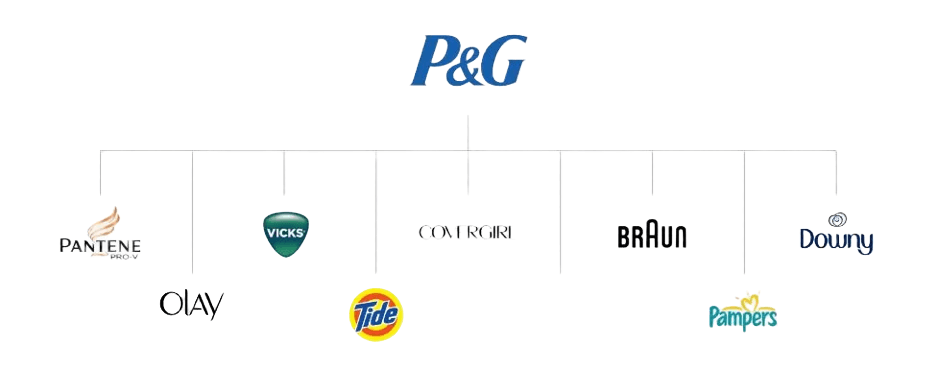
Procter & Gamble remains one of the clearest examples of this model. Its portfolio includes dozens of independent brands, each with its own positioning, voice, and customer relationship. Rather than consolidating acquisitions under a single master brand, P&G preserves existing brand equity and maintains distinct categories across the market.
The advantage is strategic: multiple brands can coexist within the same category while appealing to different consumer segments — increasing overall market share without sacrificing brand clarity.
In a No Change strategy, continuity becomes the signal. Familiarity is preserved, trust remains intact, and the transition stays largely invisible to the customer. It acknowledges the value that already exists within each brand.
Internally, this approach can also send an important cultural signal — particularly to teams within the acquired organization. Maintaining the existing brand identity recognizes the equity they have built over time and reinforces a sense of recognition following the transaction.
But continuity has limits.
A No Change strategy protects what already exists. But it may also limit the organization’s ability to express what the merger or acquisition was intended to create.
Without a clear connection between the brands, equity remains isolated. Trust, recognition, and reputation are not actively transferred from one entity to the other. In some cases, operational synergies also remain invisible — or unrealized altogether.

M&A brand strategy
Fusion
The next step along the spectrum is Fusion — a strategy that brings elements from both organizations together into a shared identity. The objective is to communicate a partnership rather than an absorption. The message is not that one brand has replaced the other, but that something larger is being built together.
This strategy serves as a visible acknowledgment that both entities contribute meaningful value to the future brand.
It can help create balance during integration, especially when each organization brings strong equity, customer’s relationship, or cultural significance to the table. Rather than preserving complete separation, a Fusion approach signals connection. Brand names, visual systems, messaging, or other identity assets from each company are combined to create a new expression of the organization moving forward.
That said, combining identities introduces complexity. The challenge is not simply blending logos or names — it is creating a coherent system that feels intentional, credible, and strategically aligned. When poorly executed, fusion can create diluted positioning, visual inconsistency, or confusion in the marketplace.
There are four primary Fusion brand strategy approaches, each reflecting a different degree of integration and transformation.
M&A brand strategy
2. Straight fusion
A Straight Fusion brand strategy is the most direct form of brand integration. Two company names are combined into a single identity, preserving recognition from both sides of the transaction.
The objective is clarity and continuity: retaining existing brand equity while publicly signaling a formal union.
ExxonMobil remains one of the most recognized examples of this approach. Following the 1998 merger between Exxon and Mobil, the combined organization adopted a blended corporate identity that carried both legacy names forward.

This strategy works particularly well when each brand holds significant market equity, and neither can easily disappear without sacrificing value or stakeholder confidence.
M&A brand strategy
3. Fusion modernisée
A Refreshed Fusion brand strategy follows a similar logic but introduces a stronger sense of evolution.
The names may still be combined, yet the visual identity — typography, symbol, iconography, or overall design system — is newly created to express momentum and transformation.
PwC is a clear example. After the merger, the new organization retained both names while launching a redesigned visual identity that reflected a forward-looking direction. The result balanced continuity with renewal: preserving existing equity without appearing static.

This approach is often effective when organizations want to reassure existing audiences while also marking the beginning of a new chapter.
M&A brand strategy
4. Fusion hybride
Hybrid Fusion combines selected assets from each brand into a single identity system.
Rather than merging names equally, the strategy blends specific elements — such as a name from one organization and a logo or visual system from the other.
When United merged with Continental Airlines, the resulting identity adopted the United name while retaining Continental’s globe symbol. The brand became a composite: familiar, but strategically reassembled.

Hybrid Fusion can help preserve the strongest equity from both organizations while avoiding the complexity of a full dual-name structure. It also allows leaders to shape perception more selectively, emphasizing the assets with the greatest market value.
M&A brand strategy
5. Endorsed fusion
Endorsed Fusion introduces a parent-child relationship within the brand architecture.
In this model, the acquired brand remains visible but is publicly connected to the acquiring organization through endorsement language or identity cues.
When Gannett acquired CareerBuilder, the brand evolved into “careerbuilder.com, a Gannett company.” The endorsement created association and credibility without removing the acquired brand’s existing recognition.

This strategy is often used when the acquired company has strong standalone awareness or customer trust, but the parent organization wants to reinforce ownership, scale, or strategic alignment over time.
It offers a gradual path toward integration while maintaining continuity in the market.
Fusion strategies are often designed to reduce disruption rather than redefine the future.
They help preserve familiarity, reassure stakeholders, and soften the impact of integration — particularly when both organizations bring meaningful brand equity to the table. In that sense, Fusion is fundamentally a risk-management approach.
But compromise can come at a cost. Fusion strategies can sometimes feel overly complex, visually heavy, or lacking in distinctiveness — creating uncertainty around positioning, differentiation, and customer trust.

M&A brand strategy
Stronger horse
The Stronger Horse approach elevates one brand over the other.
Rather than combining equities equally, the organization identifies the identity with the greatest long-term strategic value — whether based on reputation, market recognition, growth potential, customer trust, or cultural relevance — and builds forward from there.
There are four primary variations of the Stronger Horse strategy.
M&A brand strategy
6. Stronger horse forward
This is the most common version of the model.
The acquiring or lead company retains its name and identity, while the acquired brand is gradually or immediately absorbed into the dominant system.
From a market perspective, the transition is straightforward: one brand continues forward, strengthened by the acquisition behind the scenes.
When DHL acquired Airborne Express, the Airborne brand disappeared and its operations were integrated entirely under DHL. The strategy prioritized clarity, scale, and operational cohesion.

Stronger Horse Forward works particularly well when one brand already holds significantly greater global awareness or category authority.
M&A brand strategy
7. Reverse stronger horse
Reverse Stronger Horse flips the expected hierarchy.
In this scenario, the acquiring organization adopts the name or identity of the acquired company because the acquired brand is strategically stronger — even if the company itself is smaller.
A well-known example is the merger between First Union and Wachovia. Although First Union was the larger institution, reputational challenges weakened its brand equity. Wachovia, by contrast, carried stronger public perception and greater long-term brand potential.
The merged organization ultimately moved forward under the Wachovia name.

This strategy recognizes an important truth: brand strength is not determined solely by size. Perception, trust, and future positioning often matter more.
M&A brand strategy
8. Phased stronger horse
Phased Stronger Horse creates a temporary bridge between two identities before ultimately consolidating under one.
Early in the integration process, both brands remain visible to help customers, employees, and markets adjust gradually. Over time, the weaker or secondary identity is retired.
When Medtronic merged with Midas Rex, the organization initially operated as Medtronic Midas Rex before eventually simplifying to Medtronic alone.

This phased approach offers strategic flexibility. It allows organizations to preserve continuity during transition, educate stakeholders progressively, and delay permanent decisions while integration evolves internally.
In many cases, it also reduces the abruptness that can accompany immediate brand elimination.
M&A brand strategy
9. Refreshed stronger horse
Refreshed Stronger Horse maintains the lead company’s name while updating the visual identity to reflect change.
The dominant brand introduces a refreshed logo, symbol, typography, or color system to signal that the company has evolved through the transaction.
The intention is subtle but important: preserve familiarity while acknowledging transformation.
When executed well, this strategy creates continuity without appearing static. Existing brand equity remains protected, yet the updated identity communicates renewed ambition, expanded capability, or a broader market position.

It is often one of the most balanced approaches — and its advantage lies in its clarity.
It establishes a single direction for the organization, simplifies market communication, and creates a more unified platform for operations, culture, and growth. From a brand architecture perspective, it is often the most efficient path forward.
But efficiency can create friction. When one identity becomes dominant and the other disappears, the merger can begin to feel less like integration and more like absorption. Internally, this dynamic can create a perceived winner-and-loser mentality, weakening morale, trust, or cultural alignment across teams.
Externally, the risks are equally significant. Whenever a brand disappears, stakeholders are forced to reconsider their relationship with the organization that replaces it.

M&A brand strategy
10. New brand
At the far end of the spectrum is the most transformative option: creating an entirely new brand.
Rather than preserving or combining existing identities, the organization starts from zero — developing a new name, narrative, and visual system designed specifically for the future entity.
This approach is typically reserved for moments of profound industry change or strategic reinvention. It is less about integration and more about repositioning.
When GTE and Bell Atlantic merged to form Verizon, the telecommunications industry was entering a major shift toward mobile connectivity and digital infrastructure. Both legacy brands carried strong regional recognition, but they were also tied to a previous era of telecom.
Launching Verizon allowed the combined organization to signal something larger than a merger: a new direction entirely.

The New Brand strategy carries significantly more risk. It abandons established equity, familiarity, and historical recognition in favor of long-term strategic potential. Customers, employees, and investors must all learn a new identity at once. If the new brand lacks clarity or meaning, the organization can lose years — even decades — of accumulated trust.
But when successful, a New Brand strategy creates something the other strategies cannot: complete freedom to redefine perception.
It allows the organization to move beyond legacy limitations, competitive baggage, or outdated market associations and position itself around a shared future rather than inherited histories — turning the merger itself into a catalyst for reinvention.
Creating an entirely new brand following a merger or acquisition is one of the most demanding paths an organization can take. Yet when executed strategically, it creates the opportunity to define a position built for the future rather than the past — a freedom that can become a powerful strategic advantage.

In conclusion
Ultimately, every M&A brand identity decision communicates something deeper than structure alone.
It signals ambition.
It shapes perception.
It influences how employees, customers, investors, and the market interpret the future of the organization.
The most effective post-merger brand strategies do more than reduce confusion or manage transition. They create alignment between business vision and market perception — balancing risk, continuity, and long-term growth potential.
To learn more about M&A branding strategies and discover how to strengthen your brand acquisition or acquisition efforts. Contact us today.